
Artemis II: Humans Fly Around the Moon Again
Four astronauts will travel around the Moon and return to Earth on a ~10-day mission that tests deep-space systems and advances lunar science.

Launch: no earlier than Feb 6, 2026 (date may shift based on readiness and conditions)
Mission duration: ~10 days
Moon landing: No — this mission is a lunar flyby / free-return style trajectory (around the Moon and back).
What is Artemis II?
Artemis II is NASA’s first crewed mission of the Artemis campaign. The crew will launch on the Space Launch System (SLS) and fly in the Orion spacecraft on a journey around the Moon and back to Earth. The mission is designed to confirm Orion’s systems perform as expected with humans onboard in deep space—an essential milestone before future lunar surface missions.
Quick Facts:
- Crewed Orion mission around the Moon and back
- ~10 days in deep space
- Tests spacecraft systems and supports science investigations
The Flight
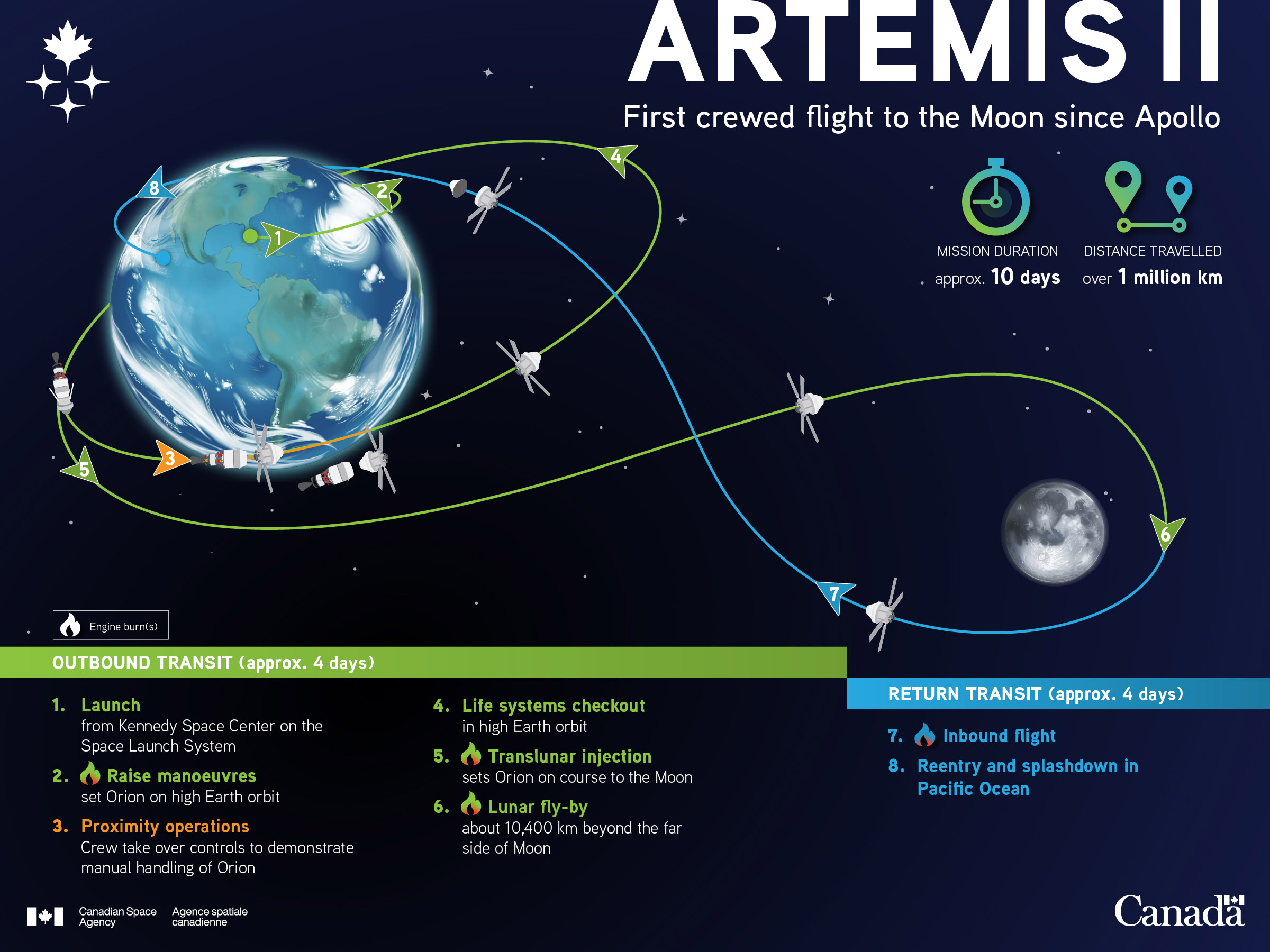
Here's the mission journey, step-by-step.
- Launch (Florida): Orion launches on SLS from Kennedy Space Center.
- Earth-orbit checkouts: Orion orbits Earth and crews verify systems while still close to home.
- Outbound to the Moon: Orion heads into deep space en route to lunar flyby.
- Far-side lunar flyby (science window): During a key period near the Moon, the crew observes and photographs lunar features.
- Return to Earth: Orion begins the trip home.
- Splashdown & recovery: Orion lands in the ocean and is recovered by teams at sea (location depends on mission plan).
Launch date note: Feb 6, 2026 is the earliest possible launch date. If a launch attempt is scrubbed, NASA has additional opportunities in the launch window. Timing can change due to weather, range availability, or technical readiness.
Mission Objectives
Artemis II is a proving ground: the crew will help validate how Orion performs in deep space, life support, navigation, communications, and crew operations, while working with teams on Earth to support science and real-time mission decision-making.
Objective list:
- Crewed systems verification: Confirm spacecraft systems work as designed with astronauts aboard in deep space.
- Lunar science “observe & record”: Capture observations and images of craters and ancient lava flows to help inform future exploration (including skills needed for future missions).
- Astronaut health studies: Collect data on how deep space travel affects the body, mind, and behavior to improve protections for future missions.
- Space weather readiness: Use real-time monitoring and forecasting to help protect crew and systems from solar events.
Science on Artemis II
What we'll learn in deep space.
- Lunar Science:
As Orion flies by the Moon, astronauts will act as “scientific ambassadors,” using geology training to observe and photograph features like impact craters and ancient lava flows—the kinds of details that help reveal the Moon’s geologic story.
- Real-time operations:
A science team on Earth will support the crew with real-time analysis and guidance from mission control, helping connect what the astronauts see with mission goals and future planning.
- International science + CubeSats:
Several international partners are flying CubeSats with their own objectives, deployed in high Earth orbit, alongside additional research such as radiation studies.
Canada in Artemis
Canada is a core Artemis partner. Through its contributions - especially Canadarm3 for the Gateway lunar space station - Canada gains opportunities for lunar science and technology demonstrations and secures astronaut flights, including Artemis II.
- Gateway: A small space station that will orbit the Moon and support exploration and science.
- Canadarm3: A next-generation robotic system planned to help maintain and support Gateway operations and science in lunar orbit.
- Canadian astronaut flights: Canada’s partnership includes astronaut opportunities, starting with Artemis II.
Meet the Artemis II crew
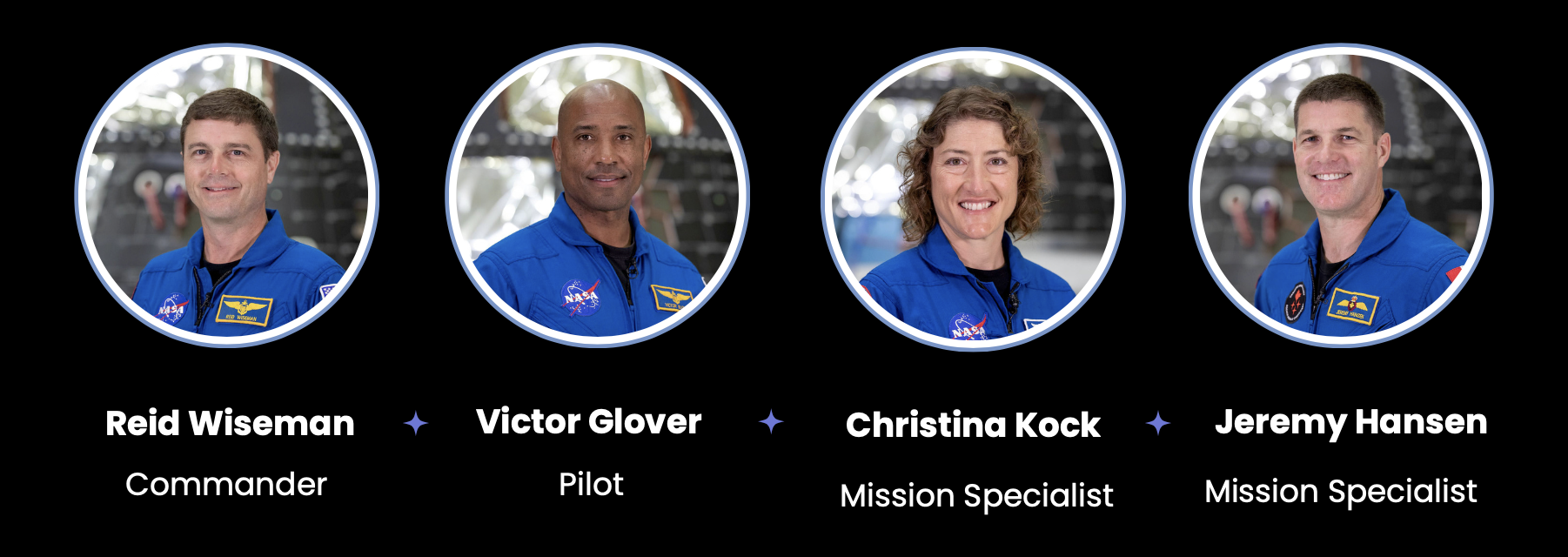
- Reid Wiseman (NASA) - Commander
- Victor Glover (NASA) - Pilot
- Christina Koch (NASA) - Mission Specialist
- Jeremy Hansen (CSA) - Mission Specialist
Get involved
You don’t have to be an astronaut to be part of Artemis. Explore activities, classroom resources, events, and ways to follow the mission.
- To-scale printable flight plan designed by Plateau Astro
- Watch Jeremy Hansen's vlogs
- Learn how to draw Artemis
- Download the crew patch
- Follow Artemis updates with the CSA
- Read Ininew (Cree) stories about the Moon
- Read the Explorer's Club E-Book
- Host a Watch Party
- Watch live coverage on NASA's YouTube channel.
- Try Artemis STEM activities and educator resources
- Amateur Astronomers: Ground-based observation of Artemis II should be possible, primarily using radio equipment but also visually when the spacecraft is in Earth orbit and during slingshot maneuvers. It is not yet clear exactly where, when (and if) the orbital information will be published, but RASC members can practice with tools like JPL Horizons to familiarize themselves with generating observational data, similar to tracking the ISS. Check back here frequently - if the data is made available, we will provide the link here. .